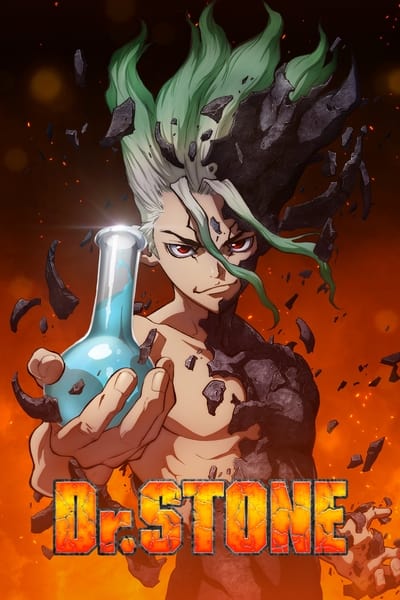
One fateful day, a blinding green light petrifies all of humanity — billions of people frozen as statues for 3,700 years. When teenage genius Senku Ishigami finally breaks free of his stone shell, he vows to rebuild civilization from absolute zero, one scientific breakthrough at a time. From stone tools to gunpowder, electricity, a cellphone, and a ship that crosses the Pacific, the Kingdom of Science climbs a two-million-year technological ladder to answer the greatest question of all: who petrified humanity — and why?
Jump to an Arc
The Petrification Event
September 2019 — Humanity Turns to Stone. The story begins with humanity suddenly being struck by a mysterious green light. Every human on Earth is petrified, and approximately 7 billion people are turned to stone. Senku Ishigami survives consciously inside his stone shell by continuously counting, and Taiju Ooki also remains conscious alongside him.
Civilization collapses completely and nature gradually reclaims human cities and infrastructure. Senku eventually estimates that approximately 3,700 years have passed. The cause of the petrification remains one of the central mysteries of the series.
Season 1 — Dr. Stone
Rebuilding civilization from scratch, from the first revival fluid to the brink of the Stone Wars.
Arc 1 · Stone World / Stone Formula (Episodes 1–2)
Episode 1 — Stone World. Senku awakens in the Stone World and immediately begins reconstructing civilization from scratch. Escaping his stone shell, he establishes that ~3,700 years have passed, creates a primitive shelter, and begins experimenting with chemistry. He discovers that nitric acid can break down the stone casing, eventually developing the revival fluid using nitric acid and alcohol — and decides that restoring humanity must begin with science. Major concept: chemical revival via a nitric-acid-based process.
Episode 2 — Two Nations of the Stone World. Senku revives Taiju — physically powerful but lacking Senku's knowledge, making them complementary partners. They hunt for food, encounter wild animals, discover that the modern world has become wilderness, and find Yuzuriha's petrified body. They ultimately revive Tsukasa Shishio, one of the strongest fighters of their generation — though Tsukasa's worldview immediately creates tension with Senku.
Arc 2 · Tsukasa Empire Conflict (Episodes 3–5)
Episode 3 — Weapons of Science. Tsukasa demonstrates his enormous physical strength and begins destroying the stone statues of adults, believing the old world's adults represent corruption. His goal is a new civilization consisting only of young people. Senku recognizes Tsukasa as his greatest threat, and the two sides come to represent fundamentally different philosophies: Senku: restore everyone vs. Tsukasa: build a new world without the old generation. Senku begins developing weapons using chemistry.
Episode 4 — Fire and Gunpowder. Senku produces gunpowder, one of the first major technological jumps of the Stone World, using it to threaten Tsukasa. He also creates a large signal fire to communicate with potential survivors — and unexpectedly, another signal appears in the distance, proving other humans are alive.
Episode 5 — Stone World vs. Tsukasa. Tsukasa discovers Senku's plans and threatens Yuzuriha to force out the revival-fluid formula. Senku refuses, and the confrontation ends with Tsukasa apparently killing him. Before dying, Senku secretly tells Taiju and Yuzuriha to continue the mission.
Arc 3 · Ishigami Village (Episodes 6–13)
Episodes 6–7 — Senku's New Beginning. Senku survives because a portion of the petrification casing remains around his neck, and discovers the signal fire came from Ishigami Village — a society preserved for generations by the descendants of astronauts who survived the original event. Meanwhile, Taiju and Yuzuriha infiltrate Tsukasa's group and secretly continue Senku's mission. Senku meets Kohaku and begins investigating the village's history.
Episode 8 — Stone Roadmap. Senku introduces modern technology to the village, establishing an industrial base: glassmaking, metalworking, agriculture, chemical production, medicine, and electricity. He also meets Chrome, a self-taught village scientist who becomes one of the Kingdom's most important members.
Episodes 9–10 — Building the Kingdom of Science. Senku discovers the villagers have never tasted many modern foods (most famously ramen) and uses this to gain support. He assembles his specialists: Chrome (experimentation), Kohaku (combat/scouting), Suika (reconnaissance), Kinro & Ginro (guards), Kaseki (master craftsman), and Ruri (village priestess). The Kingdom of Science begins to take shape.
Arc 4 · Sulfa Drug / Village Chief (Episodes 11–18)
Episodes 11–12 — The Grand Bout (part 1). Ruri is seriously ill, and Senku determines she needs a powerful medicine — the sulfa drug, an early antibiotic. Producing it requires an enormous industrial chain: glass, sulfuric acid, nitric acid, alcohol, chemical reagents, and laboratory equipment. This becomes one of the first demonstrations of the series' central idea: modern technology depends on thousands of smaller technologies.
Episodes 13–14 — Electricity. Senku and Kaseki construct a generator, giving the village electricity, light, electrical equipment, and communication tech. The creation of the light bulb represents an enormous technological milestone.
Episodes 15–16 — The Grand Bout. The village's martial tournament is held to determine its next chief; Senku enters for strategic rather than personal reasons, and ultimately becomes chief — but his primary objective remains obtaining the resources to manufacture Ruri's medicine.
Episodes 17–18 — The Hundred Tales. Ruri reveals the village's history: it was founded by Byakuya Ishigami, Senku's adoptive father and one of the astronauts aboard the ISS when humanity was petrified. The astronauts survived (they were in space during the event), returned to Earth, and established a new settlement. Byakuya created the Hundred Tales, stories designed to preserve knowledge and history — establishing a direct link between Senku and the village's founders.
Arc 5 · Cellphone / Tsukasa Conflict (Episodes 19–24)
Episodes 19–20 — The Cellphone Project. Senku realizes the Kingdom needs long-distance communication and builds a primitive cellphone, requiring copper wire, batteries, glass, vacuum tubes, electrical components, magnets, speakers, and microphones. It becomes one of the Kingdom's most important strategic weapons.
Episodes 21–22 — Preparing for War. The Kingdom prepares for a direct confrontation with Tsukasa, developing communication equipment, weapons (katanas), mechanical equipment, and reconnaissance systems. Meanwhile, Tsukasa's forces become increasingly organized, and Hyoga emerges as one of Tsukasa's strongest warriors.
Episodes 23–24 — The Stone Wars Begin. The Kingdom establishes its strategy for defeating Tsukasa without destroying humanity — winning through science + communication + strategy + manpower rather than brute force. The season ends with both factions preparing for the coming Stone Wars.
Season 2 — Dr. Stone: Stone Wars
The Kingdom of Science takes the offensive — and wins the war through information as much as firepower.
The Kingdom begins its offensive. Senku's cellphone network lets him communicate with Taiju and Yuzuriha, embedded inside Tsukasa's Empire, and Gen Asagiri becomes an important psychological weapon. Imitating voices, Gen impersonates American singer Lillian Weinberg, convincing Tsukasa's soldiers that the United States is still technologically advanced and may rescue them — making some soldiers question Tsukasa's ideology. Strategic importance: information can be as powerful as physical weapons.
The Kingdom develops a primitive motorized vehicle, the Steam Gorilla, combining steam power, mechanical engineering, metalworking, wheels, and weaponry — the Kingdom's primary mobile weapon. Meanwhile, Chrome is captured by Tsukasa's forces; rather than waiting for rescue, he uses scientific reasoning to escape, creating an improvised electrical system and exploiting the materials available to him. It proves Chrome has evolved from a village experimenter into a genuine scientist.
The Kingdom seeks control of the Cave of Miracles, the critical source of nitric acid — the key to producing revival fluid. The battle grows dangerous as Hyoga confronts the Kingdom. Senku realizes continuing the war could destroy the remaining human population, and proposes a different solution: revive Tsukasa's sister, Mirai.
Senku successfully revives Mirai Shishio, and Tsukasa finally sees that Senku isn't trying to destroy everything he believes in. However, Hyoga betrays Tsukasa, and the two sides temporarily unite against him. Senku and Tsukasa defeat Hyoga, but Tsukasa is critically injured. Because the technology to properly revive him doesn't yet exist, Senku places Tsukasa into cryogenic preservation. The Stone Wars end with the Kingdom of Science effectively victorious.
Dr. Stone: Ryusui Special
The Age of Exploration begins.
The Kingdom of Science gains a new objective: explore the world. Senku determines they need a ship, a captain, navigation and maps, oceanic transportation, large-scale food production, and fuel. He revives Ryusui Nanami, an extremely wealthy and experienced sailor, who immediately becomes one of the Kingdom's most important members.
The Kingdom creates a hot-air balloon, allowing them to survey large areas, map terrain, and search for resources — specifically oil — and to understand the geography of the Stone World. The balloon expedition becomes the beginning of humanity's return to global exploration.
Season 3 — Dr. Stone: New World
Humanity takes to the sea and across the Pacific.
Arc 1 · Age of Exploration (Episodes 1–6)
Agricultural Revolution. Realizing exploration requires enormous quantities of food, the Kingdom industrializes agriculture, notably developing bread production and experimenting with wheat cultivation and food preservation. This marks a major transition: science is no longer only about survival — it now supports large-scale civilization.
Oil Discovery. The Kingdom searches for oil — essential as fuel, transportation, chemical feedstock, industrial energy, and future machinery. They locate a deposit, but finding it is only the beginning; they still need a way to extract, refine, transport, and use it.
The Perseus. Kaseki and the Kingdom construct a massive sailing ship, the Perseus, their primary exploration vessel. It contains engines, navigation systems, communication equipment, scientific laboratories, storage, weapons, and even sonar — allowing humanity to cross the Pacific Ocean.
Arc 2 · Treasure Island (Episodes 7–14)
The Kingdom reaches Treasure Island, an important place connected to the astronauts who survived the original petrification. The island contains the resources for virtually unlimited revival fluid, most importantly platinum — an essential component in Senku's plan for the mass production of nitric acid.
The Petrification Weapon. The expedition quickly turns into a disaster. A mysterious enemy uses a strange device capable of petrifying humans — the Medusa. The Kingdom discovers the enemy can issue commands involving distance and time, and the petrification weapon becomes one of the greatest mysteries in the series.
Episodes 11–14 — Treasure Island Society. Senku, Kohaku, Gen, and Soyuz investigate the island, discovering it has developed its own society controlled by Minister Ibara, who maintains power through the threat of the Medusa. The team discovers Soyuz has a connection to the island's ruling family, and finds evidence connecting Treasure Island to the original astronauts.
Arc 3 · The Mobile Lab (Episodes 15–18)
The Kingdom constructs a mobile laboratory, letting Senku run experiments even while moving around the island, and develops increasingly advanced equipment — most importantly a primitive drone used for reconnaissance and eventually for stealing the Medusa.
Two of Treasure Island's strongest warriors become major opponents: Moz (exceptional physical ability) and Kirisame (an elite warrior trusted to operate the Medusa). The Kingdom must defeat or outmaneuver both to gain control of the island.
Arc 4 · The Petrification of Treasure Island (Episodes 19–22)
Ibara attempts to use the Medusa to eliminate his enemies. The Kingdom realizes the weapon's capabilities can potentially be turned against its user, and Senku creates a highly precise strategy involving timing, distance, revival fluid, communication, positioning, and the Medusa.
The Final Battle. Ibara attempts to petrify the entire island. Senku executes a carefully timed revival-fluid attack, and the strategy succeeds — Ibara is defeated and the Kingdom obtains the Medusa.
End of Season 3. The Kingdom now possesses one of the most powerful technologies in the Stone World, along with platinum, the Medusa, Treasure Island, new allies, a functioning global expedition force, and knowledge about the origins of the petrification technology. The next stage of the journey is no longer simply about rebuilding civilization — it is about discovering who petrified humanity, and why.
Major Scientific Progression
The technological development of Dr. Stone can be viewed as a technological ladder — each step built on the ones before it.
| Technology | Approx. Episode | Purpose |
|---|---|---|
| Revival Fluid | S1E1 | Revive humans |
| Basic Fire | S1E1 | Cooking and survival |
| Glass | S1 | Laboratory equipment |
| Gunpowder | S1E4 | Weaponry |
| Ramen | S1 | Food / morale |
| Sulfuric Acid | S1 | Chemical industry |
| Electricity | S1 | Industrial power |
| Light Bulb | S1 | Artificial lighting |
| Sulfa Drug | S1 | Medical treatment |
| Magnetism | S1 | Electrical technology |
| Cellphone | S1 | Long-distance communication |
| Katanas | S1 | Advanced weapons |
| Steam Gorilla | S2 | Transportation / warfare |
| Steam Engine | S2 | Mechanization |
| Hot-Air Balloon | Ryusui | Exploration |
| Bread Production | S3 | Industrial food production |
| Oil Discovery | S3 | Future fuel supply |
| Perseus | S3 | Ocean exploration |
| Sonar | S3 | Underwater navigation |
| Mobile Lab | S3 | Field science |
| Drone | S3 | Reconnaissance |
| Mass-Production Revival System | S3 | Large-scale revival |
| Medusa | S3 | Petrification technology |
Major Characters & Their Roles
| Character | Role in the Kingdom of Science |
|---|---|
| Senku Ishigami | Leader, scientist, engineer |
| Taiju Ooki | Strength, construction, physical labor |
| Yuzuriha Ogawa | Craftsmanship, sewing, infiltration |
| Tsukasa Shishio | Former enemy, combat specialist |
| Chrome | Inventor and developing scientist |
| Kohaku | Warrior, scout, reconnaissance |
| Suika | Reconnaissance and intelligence |
| Kaseki | Master craftsman |
| Gen Asagiri | Psychology, deception, communications |
| Kinro | Guard and warrior |
| Ginro | Guard and warrior |
| Ruri | Village leader and historian |
| Byakuya Ishigami | Founder of Ishigami Village |
| Ryusui Nanami | Captain, navigator, explorer |
| Francois | Chef and logistics specialist |
| Soyuz | Treasure Island connection |
| Mirai Shishio | Tsukasa's sister |
The Major Factions
Kingdom of Science
Leader: Senku Ishigami. Goal: Rebuild civilization through science and revive humanity. Major strengths: Science, engineering, medicine, manufacturing, communication, strategic planning.
Tsukasa Empire
Leader: Tsukasa Shishio. Original goal: Create a new civilization without the adults of the old world. Major strengths: Physical combat, hunting, survival, military organization. Eventually, Tsukasa's interests align with Senku's larger goal.
Ishigami Village
A descendant community created by the astronauts who survived the original petrification. Its important legacy is the Hundred Tales, preserving knowledge of the past and providing the Kingdom of Science with its first major population base.
Treasure Island
An isolated society descended from the original survivors, whose political structure revolves around the Medusa. The island becomes critical because of its platinum, petrification technology, connection to the astronauts, and historical information.
Major Mysteries
Several questions drive the story throughout the anime:
- Who caused the Petrification Event? The identity of the person or entity responsible remains one of the central mysteries.
- What exactly is Medusa? The petrification devices are vastly more advanced than anything humanity has reconstructed.
- Why was humanity petrified? The motivation behind the event is initially unknown.
- Why did Senku and Taiju remain conscious? Their ability to maintain consciousness inside the stone becomes important to understanding the petrification process.
- What happened to the rest of the world? The Stone World contains clues suggesting humanity's survival was far more complicated than initially believed.
The Overall Story Progression
The anime's technological progression can essentially be summarized as:
Survival → Chemistry → Medicine → Electricity → Communication → Industry → Mechanization → Transportation → Ocean Exploration → Global Exploration → Petrification Technology
The scale of the story continually expands. At the beginning, Senku is trying to make fire. By Season 3, the Kingdom of Science has ships, engines, electricity, medicine, industrial chemistry, communications, aircraft, drones, advanced weapons, a global exploration program, and a device capable of petrifying humanity. That progression is one of the defining features of Dr. Stone.